

Nicollet Mall
On witness, and what it costs

JFK to MSP. Road warrior, in town for work. I skipped the car service. The light rail was easy. Fast. Cheap. I was pleased with myself for figuring it out, sliding my card, finding a seat, watching the city through the smeared windows as we pulled toward downtown Minneapolis.
And then I stepped off the train and went quiet.
I haven’t seen anything like it in a long time. Maybe ever, in an American city that wasn’t bracing for a hurricane or recovering from one. Crackheads. Homeless. People so far past desperate that there isn’t even a right word anymore. Shuttered storefronts. Buildings hollowed out and dark. And a feeling, immediate and animal, that this sidewalk is not safe. Not quite NYC unsafe, where you read the room, look it in the eye, and adjust. Something more unpredictable. Something that doesn’t follow the usual rules.
I had meetings starting at 1. I found food. I kept moving.
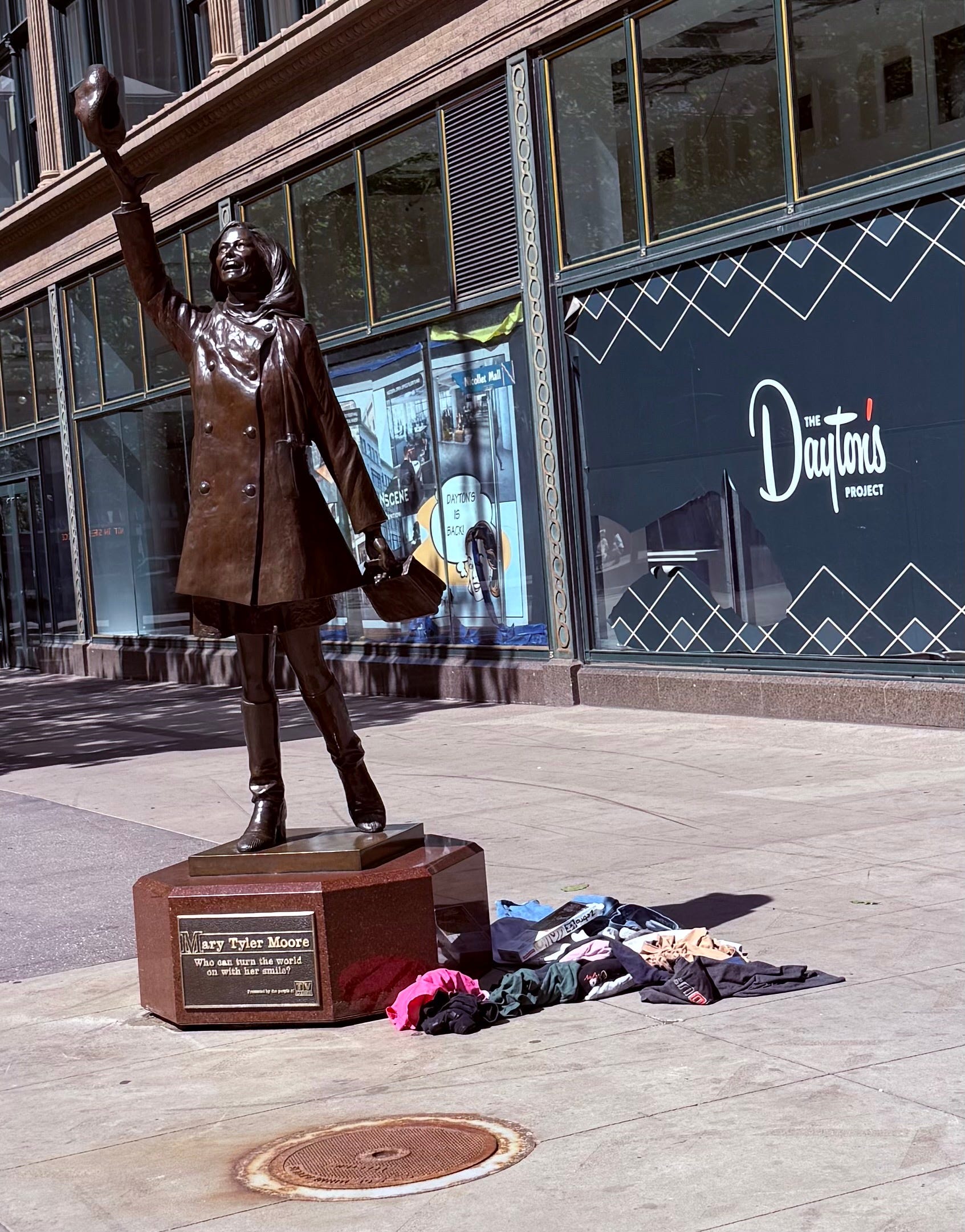
There’s a famous statue of Mary Tyler Moore on Nicollet Mall. Of course there is. She’s mid-stride, hat mid-toss, frozen in the famous moment of pure possibility. Behind her, Dayton’s, the legendary department store that defined this city for generations, sits dark and empty. Derelict. Someone had dumped a bag of old trash at the base of the statue, right where the plaque proclaims how Mary made the world smile.
I didn’t take a picture of the crackheads. I took a picture of her.
I stood there for a moment with the classical music playing, because yes, classical music was blasting from speakers somewhere along the mall to supposedly deter crime, violence, and the unpredictability I mention, and I thought about the cruelty of that image. The frozen optimism. The trash. The empty store. The music. I have spent thirty years filling Carnegie Hall with it. On Nicollet Mall, they point it at the street. All of it coexisting on a Wednesday as if someone had designed it as an art installation about the death of the American middle.
On the train back to the airport a few days later, I watched.
This is what sobriety gave me, among other things. I watch now. I don’t perform obliviousness. I don’t arrange my face into the careful blankness of someone who has decided not to see.
The guy in the purple fuzzy bathrobe, pants below his butt, gold Rolex, diamonds spelling MVP around his neck. Eyes moving. Always moving. The men, also moving, sidling up one by one, slipping him tiny envelopes, lighters, small transactions conducted in plain sight. Smooth and practiced. Broad daylight.
Around them, Minnesotans with actual paper books and slurping from the bright sippy straws of stupidly oversized multi-gallon water bottles, headphones in, eyes down. Their t-shirts doing the work their eyes refuse to. Woke slogans in careful fonts proclaiming solidarity with everything except what was happening three feet away. Their invisible bubbles, carefully maintained, airtight. The ability to say later, genuinely, I didn’t see anything.
I sat at attention, at the edge of my hard train seat. I didn’t put my headphones in. I watched the whole transaction.
I wanted to shake someone. HOW. How do you not see this?
But I know how. I spent years not seeing things. Not seeing what was happening at my own dinner table, in my own wine glass, in the mirror. Obliviousness isn’t always stupidity. Sometimes it’s survival. Sometimes it’s a skill you develop so slowly you don’t realize you’ve become an expert.
That doesn’t make it okay.
Earlier, I had been listening to Marco Polo video messages from women in my sober community. Beautiful, tender messages, full of the fragile joy of being truly known by someone for the first time. Women finding each other across distances, crying with relief at the recognition. It’s real. I know it’s real because I’ve felt it.
But I kept thinking, on that train, about the distance between that joy and this. Between the warmth of a private community and the cold fact of a man nodding out against a wall at noon. Both are real. Both are happening simultaneously in this country. And most of us, most of the time, have chosen which reality we live inside.
I came here for a choral conference. Classical music, concert halls, the pleasure and celebration of voices in unison. And instead, Minneapolis handed me this: a woman frozen mid-possibility with trash at her feet, and a train full of people who had learned, very successfully, not to look.
This is what I see now, with a clear and sober mind. I don’t always know what to do with it. But I cannot unknow it.
The music kept playing.
If you’re new here, this is Camera Dark Notes — where I write about what a clear-eyed life actually looks like. Not always comfortable. Free, and worth the trip: irisdnyc.substack.com.
Wow, Iris. I can “see”” all of that in my mind’s eye as if I had been there myself. You truly have a gift of bring the written word to life, my friend. If only the people living there (and similar places all around the world) would see and take action to make a positive change in their community.
Yes. Whether it be the inattentive stance to not see or the judgments without any compassion or empathy as to what may have occurred to another person to bring them to such states, callousness towards the stranger in our midst, it’s truly disheartening. And then social media, the bullies behind the keyboards, safety from afar to inflict pain towards others, often people they don’t know and sometimes friends, family, acquaintances- things they would hesitate to say to another’s face. Being aware with compassion and curiosity is a much better stance.